Andrew Carnegie: Steel, the Gospel of Wealth, and Homestead
He gave away ~90% of one of history’s great fortunes and funded 3,000 libraries — and built the money by methods that broke a union and left people dead. A fact-checked look at the giver and the taker as one man.
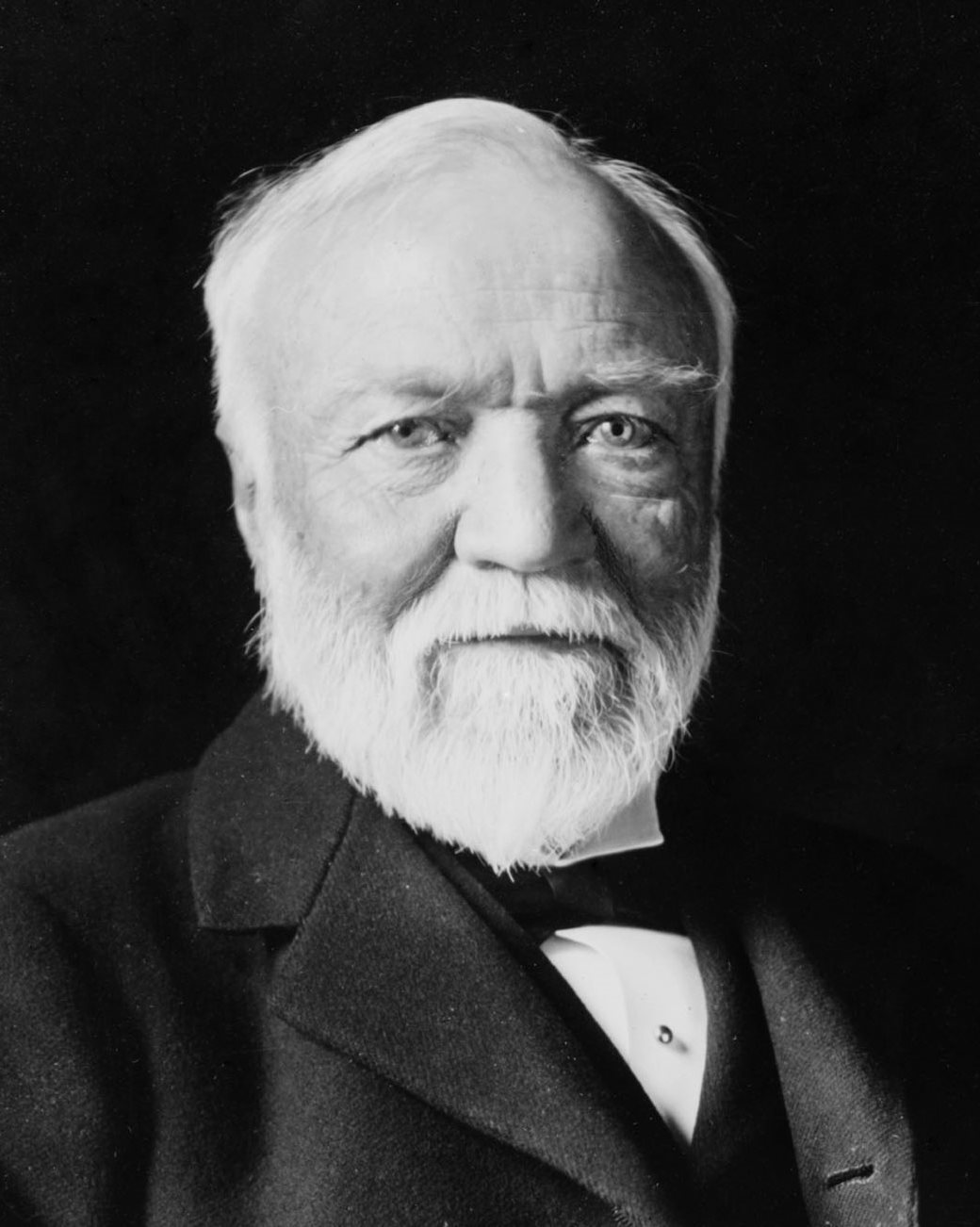
Andrew Carnegie is the most quoted philanthropist in the history of capitalism and one of its most ruthless industrialists, and the uncomfortable fact at the centre of his life is that those two descriptions are not in tension — they are the same story told from two ends. The man who gave away roughly ninety per cent of an immense fortune, who funded some three thousand public libraries, who wrote an essay arguing that the rich have a moral duty to die nearly broke, was also the man whose company crushed a union in a battle that left people dead, who cut workers' wages while preaching the dignity of labour, and who built the fortune he later distributed by methods he would never have endorsed in print. To study Carnegie honestly is to refuse the comfortable separation of the giver from the taker, and to sit instead with a single person who was emphatically both.
He is also the rare titan whose life reads like a deliberate parable of the age that produced him. He arrived in America a penniless Scottish immigrant boy and died one of the richest men who had ever lived; he embodied, more completely than almost anyone, the promise and the cost of the American Gilded Age. The promise was real — a bobbin boy genuinely did become the master of an industry. The cost was real too, and it was paid by other people. This is a case study in how those two truths coexisted in one extraordinary, contradictory life.
From Dunfermline to Allegheny
Andrew Carnegie was born on 25 November 1835 in Dunfermline, Scotland, the son of a handloom weaver in a trade that the industrial revolution was in the process of destroying. The power loom was making skilled hand-weavers like his father redundant, and the family slid into genuine poverty — a fact worth holding onto, because the experience of watching mechanisation wipe out a traditional craft sat at the root of a man who would later mechanise relentlessly himself. In 1848, when Andrew was twelve, the family emigrated to the United States in search of work, settling in Allegheny, Pennsylvania, near Pittsburgh, among other immigrants and into hardship.
There was nothing inevitable about what followed. The boy went to work almost immediately, first as a bobbin boy in a cotton mill for a pittance, then as a telegraph messenger. It was the telegraph that opened the door. Carnegie was sharp, ambitious, and unusually good at making himself useful to powerful men; he taught himself to read telegraph signals by ear, made himself indispensable, and was noticed. That capacity — to attach himself to the right patron and the right technology at the right moment — would define his entire ascent.
The railroad years and the lessons of capital
Carnegie's real education in business came from the Pennsylvania Railroad, the largest and most sophisticated corporation of its era. He joined as a young man under the patronage of Thomas Scott, a senior railroad executive who took him on as a personal telegrapher and assistant and effectively mentored him in the mechanics of large-scale industrial management. Carnegie rose quickly through the railroad's ranks, absorbing two lessons that would make him rich.
The first was operational: he learned how a great enterprise actually ran — cost control, the management of capital-intensive infrastructure, the discipline of measuring everything. The second was financial: through Scott he learned to invest, putting money into railroad-related ventures, bridge-building concerns, and the iron and oil businesses that fed the railroads. By the time he left the Pennsylvania Railroad, Carnegie was no longer a salaried employee climbing a ladder; he was a capitalist with a portfolio, an instinct for where industrialising America was heading, and the conviction that the future belonged to whoever could supply the materials of that growth. He bet on iron, and then, decisively, on steel.
Building the steel empire
Carnegie's genius was not invention; it was integration and obsession. He did not discover the Bessemer process for making cheap steel — he saw its potential on trips to Britain and imported it with single-minded conviction. What he brought was a relentless focus on driving down the cost of production. He built modern mills, adopted the best available technology, measured costs at every stage, and reinvested profits ferociously back into ever more efficient plant. His operating philosophy can be summarised as a kind of creed: watch costs and the profits will take care of themselves; run full and run hard, especially when competitors retrench; and own as much of the supply chain as possible so that no one else can take a margin from you.
That last principle — vertical integration — was the structural masterstroke. Carnegie's enterprise came to control not just the steel mills but the iron-ore sources, the coke that fuelled the furnaces, the railroads and ships that moved the materials. By owning the chain from raw ore to finished steel, he insulated himself from suppliers and squeezed out cost at every link. The Carnegie Steel Company, formed in 1892 to consolidate his holdings, became the most efficient and most profitable steel producer in the world, the dominant force in an American steel industry that was, in those decades, the literal infrastructure of a nation laying railroads, raising cities, and building bridges across a continent. Carnegie's steel was, quite physically, the skeleton of industrial America.
The 1892 Homestead Strike
No honest account of Carnegie can move past 1892 quickly, because the Homestead Strike is the event where his philosophy met its human cost in the open, and it is documented as fact, not interpretation. The Homestead Works near Pittsburgh was one of Carnegie Steel's flagship plants, and it was organised by one of the strongest craft unions of the era, the Amalgamated Association of Iron and Steel Workers. In 1892 the company sought to break the union's power and cut wages, and the resulting confrontation lasted some 143 days.
The decisive feature of the episode — and a defining ambiguity of Carnegie's character — is where he was during it. Carnegie was in Scotland. He had left the on-the-ground management of the dispute to his ruthless and capable partner, Henry Clay Frick, the chairman of Carnegie Steel, who was determined to break the union and operate Homestead non-union. Frick locked the workers out, fortified the plant, and hired roughly 300 agents from the Pinkerton detective agency to secure it and protect strikebreakers. On 6 July 1892, when the Pinkertons attempted to land at the plant by barge, the workers met them, and a pitched battle erupted. About ten people were killed — roughly seven strikers and three Pinkertons — and hundreds were injured. The state militia was eventually sent in, the strike was broken, and the plant reopened without the union. Unionised steel labour in the region was set back for decades.
The role Carnegie played, and did not play, has been argued over ever since, and the honest reading resists letting him off easily. He was abroad and did not give the order to fire; Frick ran the operation. But Carnegie owned the company, shared the goal of breaking the union, had communicated as much, and had left a man he knew to be uncompromising in charge while he was conveniently out of the country and out of the headlines. Whether his absence was coincidence or calculated distance, the result served his interests and his reputation in a way that was at minimum convenient. He privately professed anguish over the violence; he did not reverse its outcome, and the non-union, lower-wage settlement stood. The most defensible verdict is that Homestead was the predictable consequence of Carnegie's own commitment to cost-cutting and managerial control, executed by his chosen agent, and that his physical distance does not erase his ownership of it.
The sale to Morgan and U.S. Steel
By the end of the 1890s Carnegie was the dominant steelmaker in America and, increasingly, a man whose attention was turning from accumulation to disposal. In 1901 he sold the Carnegie Steel Company to a syndicate led by the financier J. P. Morgan for 303,450,000 dollars. Carnegie's personal share of the proceeds came to roughly 225.6 million dollars, taken in five per cent gold bonds — an almost unimaginable private fortune for the era. Morgan folded Carnegie Steel into a vast new combination, the United States Steel Corporation, which became the first billion-dollar company in history, capitalised at around 1.4 billion dollars.
The sale is often told as a clean retirement, but it carries its own quiet significance. Carnegie was cashing out of the brutally competitive business of making steel at exactly the moment he intended to devote the rest of his life to giving the proceeds away. The fortune that would fund the libraries, the universities, and the foundations was crystallised in that transaction. The money came from the mills — from the integration, the cost-cutting, and yes, from the broken union at Homestead — and it passed, in a single stroke of high finance, into the hands of a man who now meant to spend his remaining years convincing the world that men like him had a duty to disburse it.
The Gospel of Wealth
Carnegie's most lasting intellectual contribution is the essay he published in 1889, known as "The Gospel of Wealth," and it deserves to be taken seriously on its own terms because it is far more radical than its reputation as rich-man's piety suggests. Its core argument is that the man of great wealth has a moral obligation not merely to be generous but to administer his entire surplus fortune, during his own lifetime, for the good of the community — that to die rich is, in Carnegie's famous phrasing, to die disgraced.
The essay went further than vague exhortation. Carnegie argued that large fortunes should be heavily taxed at death, explicitly endorsing steep estate taxes and progressive taxation as a way of pressuring the rich to give while they lived rather than hoarding for their heirs. He was scornful of inherited wealth, believing it sapped the energy and character of those who received it. And he insisted that genuine philanthropy meant not indiscriminate charity to individuals — which he thought encouraged dependency — but the funding of institutions that would help people help themselves: libraries, schools, universities, parks. It was, in its way, a coherent and demanding social philosophy, and one that anticipated arguments about wealth and obligation that remain live today.
It was also, inescapably, the philosophy of a man who had built his fortune by paying his workers as little as he could. The Gospel of Wealth contains no real reckoning with how the surplus to be so nobly distributed was generated in the first place. It treats the accumulation as a settled fact and concerns itself only with the disbursement. A worker at Homestead might reasonably have asked why the great man's duty began only after the wages had been cut and the union broken — why the obligation was to give the money away grandly later rather than to share it more fairly at the point it was earned. That question is the unbridgeable gap in Carnegie's thought, and an honest account names it rather than smoothing it over.
The libraries and the giving
Whatever one concludes about its origins, the scale of Carnegie's giving was genuinely staggering and genuinely transformative. He gave away roughly 350 million dollars — on the order of ninety per cent of his fortune — in his lifetime and through the foundations he established. The most famous fruit was the network of public libraries: Carnegie funded the construction of approximately 3,000 libraries across the United States, Britain, and beyond, typically on the condition that the local community supply the site and commit to funding the library's operation, so that his gift seeded a lasting public commitment rather than a one-off donation.
The library programme was a precise expression of the Gospel of Wealth in action. Carnegie, the self-taught immigrant boy who had risen partly on access to a private library opened to working boys, believed the public library was the ideal philanthropy: it helped only those willing to help themselves, it built character and capacity, and it endured. Beyond libraries he endowed universities and research institutions, founded a major teaching and pension institution for educators, established trusts and foundations that outlived him by more than a century, and funded the building of a great concert hall in New York that still bears his name. He poured money into the cause of international peace in his final years, and was bitterly disappointed by the outbreak of the First World War, which he did not live long to see through. He died on 11 August 1919 in Lenox, Massachusetts, having achieved the goal his own gospel set him: he had given away the overwhelming bulk of his fortune before he died.
The contradiction, engaged honestly
This is the heart of the matter, and the place where a serious profile must refuse to flinch in either direction. Carnegie was simultaneously one of the most generous men who ever lived and one whose generosity was funded by practices he would never have defended in his own moral writing. The same man wrote movingly about the dignity of the working man and presided over a company that broke its workers' union by force; preached that great wealth was a sacred trust to be administered for the common good and built that wealth by extracting maximum labour at minimum cost; argued that the rich owed everything to the community and ran an enterprise whose central discipline was to give the community's workers as little as the market would bear.
There are two cheap ways to resolve this, and both should be refused. One is the hagiographic reading: that the libraries and the peace endowments wash away Homestead, that a man should be judged by his gifts. The other is the cynical reading: that the philanthropy was mere reputation-laundering, a calculated purchase of a legacy with money taken from the workers it was denied to. The honest position is harder and more interesting than either. The giving was real, vast, and did genuine, lasting good — millions of people have used those libraries, and Carnegie meant his gospel sincerely. The taking was also real, and the people who paid for the philanthropy, in cut wages and broken bargaining power, were not consulted about whether they would rather have had a library or a living wage. Both things are true at once. Carnegie does not resolve into a hero or a villain; he resolves into a Gilded Age industrialist of extraordinary ability and extraordinary contradiction, and the most useful thing a reader can do is hold the whole of him in view.
What Carnegie understood about the modern economy
It is worth pausing on what Carnegie actually understood, because his commercial insight was real and is instructive beyond the moralising. He grasped, earlier and more completely than most of his contemporaries, that the decisive advantage in a capital-intensive industry is cost, and that cost is conquered not by cleverness in selling but by ruthlessness in producing. While rivals worried about prices and markets, Carnegie obsessed over the cost of a ton of steel and drove it relentlessly down through scale, technology, and integration. He understood that in a commodity business the low-cost producer wins in good times and survives in bad ones, and he organised his entire enterprise around becoming and remaining that producer.
He also understood the counter-cyclical logic that still governs heavy industry. When demand slumped and competitors cut back, Carnegie expanded and modernised, buying and building when assets were cheap, so that he emerged from each downturn larger, more efficient, and better positioned than before. He understood the value of attaching himself to a dominant technology at the moment of its rise — the telegraph, the railroad, the Bessemer converter — and riding the wave of an industrialising nation's appetite for the things he could supply. These are durable lessons in industrial strategy, and they are part of why he is studied. The harder lesson, which the admiring business literature often skips, is that this same relentlessness, applied to labour as to ore, is what produced Homestead. The cost discipline that built the empire and the wage-cutting that broke the union were not two separate Carnegies. They were one method, applied without sentiment to everything, including people.
The legacy, weighed
The institutions Carnegie built have outlived him by more than a century, and that durability is itself a kind of verdict. The libraries seeded reading and self-improvement for generations; the universities and research bodies and foundations he endowed continue to fund education, scholarship, and the cause of peace; the model of large-scale, institution-building philanthropy that he articulated in the Gospel of Wealth became a template that later titans, from his own era to the present, have consciously followed. When the wealthiest people of later centuries pledge to give away their fortunes during their lifetimes, they are, knowingly or not, writing in the tradition Carnegie founded. As a philanthropist he was not merely generous; he was structurally influential, shaping how the very rich think about their obligations.
And yet the weighing cannot stop at the institutions, because the cost was borne by people whose names are not carved over any library door. The steelworkers whose wages were cut, the union that was broken at Homestead, the families of those killed on 6 July 1892 — they were the other half of the ledger, and Carnegie's gospel offered them grandeur of a kind they had not asked for and could not eat. The fairest summary is that Carnegie did enormous, lasting public good with money obtained by methods that did real harm to the workers who generated it, and that he sincerely believed the former discharged his duty without ever honestly confronting the latter. He is the founding case study of modern philanthropy and a permanent argument about whether giving on a heroic scale can ever fully answer for how the fortune was made.
The honest verdict
Andrew Carnegie was a genuinely great industrialist and a genuinely great philanthropist, and he was also a man whose greatness in both fields was inseparable from a hardness that cost other people dearly. The poor immigrant boy who became the master of American steel really did embody the upward promise of his age, and the fortune he built really did, by his own design, end up funding libraries and learning and the pursuit of peace on a scale the world had never seen from a private individual.
But the same drive that built the empire broke the men who worked in it, and the gospel that so nobly governed the giving was silent on the taking. The honest verdict is not a score that nets the libraries against Homestead and declares a winner; it is the refusal to do that arithmetic at all. Carnegie is the proof that a person can do immense good and immense harm with the same hands and the same character, and that the most generous philanthropist of his century was also one of its most uncompromising bosses — not by contradiction, but because both flowed from a single, relentless will. To remember only the libraries is to flatter him; to remember only Homestead is to miss what he built. The discipline is to remember all of it.
Editor's note: HustleMemo writes founder-led case studies grounded in the historical record. The 1892 Homestead Strike and its deaths are reported as documented fact; Carnegie was in Scotland and his partner Henry Clay Frick directed the response. The sale price of 303,450,000 dollars and Carnegie's roughly 225.6 million dollar personal share are used as the figures of record. We present his philanthropy and his labour practices together, without resolving the contradiction. Corrections: editorial@hustlememo.com.
Sources
- "Andrew Carnegie," Wikipedia (born 25 November 1835 Dunfermline; emigrated to Allegheny, Pennsylvania in 1848 aged 12; bobbin boy and telegraph messenger; rose through the Pennsylvania Railroad under Thomas Scott; Carnegie Steel Company formed 1892; died 11 August 1919 in Lenox, Massachusetts).
- The 1901 sale to a J. P. Morgan-led syndicate for 303,450,000 dollars (Carnegie's personal share ~225.6 million dollars in 5% gold bonds) and the formation of U.S. Steel, the first billion-dollar corporation (~1.4 billion dollar capitalisation).
- "The Gospel of Wealth" (1889): the duty of the rich to give away their fortunes in their lifetime, support for progressive and estate taxation, and the doctrine that to die rich is to die disgraced.
- The 1892 Homestead Strike: a 143-day confrontation at the Homestead, Pennsylvania works; Henry Clay Frick's hiring of ~300 Pinkerton agents; the 6 July clash that killed about 10 people (roughly 7 strikers and 3 Pinkertons) and injured hundreds; the plant reopened non-union.
- Reporting and historical scholarship on Carnegie's philanthropy: roughly 350 million dollars given away (about 90% of his fortune), including the funding of approximately 3,000 public libraries.
More from this category

Aliko Dangote: The Trader Who Built Africa’s Biggest Industrial Empire
A critically-neutral profile of Aliko Dangote: heir to a trading dynasty who built Africa’s biggest industrial empire through backward integration and scale, rode Nigeria’s protectionist policy, bet ~$20bn on a giant refinery — and faces genuine, unresolved questions about market concentration and government ties.

Sir Brian Souter: Stagecoach and the Fortune Built on a Policy
Sir Brian Souter co-founded Stagecoach and turned the deregulation of Britain’s buses into a transport empire. A sourced, critically neutral look at genuine industrial achievement, the proven "predatory" competition findings, the controversial "Keep the Clause" campaign, and the disputed claims about his SNP donations.

Stef Wertheimer: ISCAR and the Industry-for-Peace Vision
Stef Wertheimer turned a one-man backyard shop in Nahariya into ISCAR, the carbide-tool multinational that became Warren Buffett’s first foreign acquisition. A sourced, critically neutral case study of a near-spotless industrial fortune and the debated efficacy of his "industry for peace" vision.